Share
Results 1 to 20 of 43

Thread: Another new guy from WA

Hybrid View

Previous Post Previous Post   Next Post Next Post
  1. #1

    Default

    Thanks for the warm welcome guys!

    Sorry I haven't posted anything yet, but I've been down with the flu since Thursday night. I haven't even had a chance to fire up the new unit yet. I'm just now recovered enough that I plan on going back to work tomorrow.

    I should get a chance to try out the new SuperCut50 this weekend. First order of business will be the crossmember and motor mounts. Then the exhaust manifolds. I've already drawn up the plans for fabbing the manifolds out of 1-1/2" x 4" x 1/8" wall rectangular tubing. They may end up looking a little odd, but due to the very limited clearance space available, the rect tube is going be the best option for making manifolds with the highest flow-volume that will fit in the space available.

    I have all the material I need, its just a matter of having the time to do the work. I have only taken a few pictures so far, since I really haven't done any significant fab work yet - just a support bar that the engine is currently hanging from. I'll be sure to keep the camera handy and take lots of pictures as I go along. I'll start a separate fabrication thread once I have more to post. Stay tuned...

  2. #2

    Default

    Hi Bob,
    Please don’t take my advice as an insult but rectangular tubing does not support air flow very well. It diminishes the material vortex flow that aides in the flow of fluids (for all intensive purposes air is considered a fluid when designing). If you cannot use round tube then oval is the next best. If you are going to use rectangular then try to get the largest corner radius you can. The general rule is the least amount of bends, largest radius permissible and the shortest route possible. Sometimes with turbochargers too large of a tube may reduce velocity causing slow spool up. Good luck with the project and keep us posted. It sounds like an interesting vehicle you are building. I would like to build a small diesel with an 8 speed auto in an old street rod pick up. That’s right behind my other projects!
    Wayne

  3. #3

    Default

    Quote Originally Posted by WAYNESWORLD View Post
    Hi Bob,
    Please don’t take my advice as an insult but rectangular tubing does not support air flow very well. It diminishes the material vortex flow that aides in the flow of fluids (for all intensive purposes air is considered a fluid when designing). If you cannot use round tube then oval is the next best. If you are going to use rectangular then try to get the largest corner radius you can. The general rule is the least amount of bends, largest radius permissible and the shortest route possible. Sometimes with turbochargers too large of a tube may reduce velocity causing slow spool up. Good luck with the project and keep us posted. It sounds like an interesting vehicle you are building.
    No insult taken. I've taken fluid dynamics and recognize the validity of all of your observations.

    The problem is that I am putting a tall-decked 90* V-block into an engine compartment designed for a low-decked 60* V-block. That means the distance between the exhaust ports and the "frame rails" is only 2-1/2" to 3". The ports are 1-3/4" square and are arranged with two right next to each other (separated by a 1/4" divider) in the front on the driver's side head and the 3rd port at the back of the head. The passenger side is just the opposite with two together at the rear end of the head and the third port up front. The original manifolds have the "paired" ports on each side dumping into a common collector and piped to connect with the outlet of the third port.

    I've looked at using 1-3/8" mandrel bent tubing. The tightest radius I've been able to find is 2" u-bends from Summit or Jegs. So if I were to make the flanges out of 1/4" bar, the 1-3/8" pipe with a 2" radius bend and the 1/4" flange adds up to needing 3-7/8" clearance, and it just isn't there. I can reduce that by a little by cutting wedges out of the 90* bends to reduce the radius to less than 2", but of course every wedge cut out of the bend creates a seam and break in the flow. Even with tightening up the radius there's no way to get the required clearance down to under 2-1/2".

    There are a couple of other alternatives I've considered. One is to raise the engine a couple of inches higher. That would require modifying the hood to provide clearance - something like a LARGE, wide hood scoop. By wide I mean half the width of the hood. Unfortunately, with rain 200 days a year here in western Wasington, that isn't a very practical solution.

    The last alternative is to modify the frame rails to add clearance. Given that the Cherokee is a uni-frame and the frame members are made by layering and spot welding together heavy-gauge sheet metal stampings, I'm not very enthusiastic about the prospect of cutting on them and then trying to reinforce them to make up for it. Particularly since they are going to be supporting an engine about 50% heavier than what they were designed to support in the first place.

    I arrived at using 4" x 1-1/2" rect tube as the main collector because it will give me the maximum cross-sectional area (6 sq in) relative to the cross-sectional area of the 3 ports (which add up to just over 9 sq in combined). Compare that to using the 1-3/8" tubing - 3 of which would only give a cross-sectional area of just under 4-1/2 sq in combined. I think that having 1/3 more volumetric capacity (6 sq in vs. 4-1/2 sq in) should more than make up for the less than optimal flow.

    Probably the most significant benefit of all is that I can also weld the square tube directly to the flanges and end up with an assembly that only requires 1-3/4" clearance (1/4" flange and 1-1/2" tube). While the square tube won't give the best flow - due to the lack of swirl (vortex) action, it should give fairly decent laminar flow, particularly with the rounded corners I am incorporating into the design. It will also be transitioning to conventional round exhaust pipe as quickly as possible.

    One other thing to keep in mind is that the exhaust flow from BOTH manifolds is eventually all going to be squeezed down through a single 1-3/4" x 2-3/4" opening (just over 4 sq in) at the turbo input flange. Compared to the restriction of going through that small of an opening, the negative effects of the non-vortex flow upstream of that point should pale to insignificance by comparison.
    Last edited by R Counts; 12-02-2009 at 06:58 AM.

  4. #4

    Default

    Well, between having to work half a day on Saturday and spending Sunday doing oil changes and necessary maintenance on our daily driver vehicles I still haven't had a chance to try the new plasma cutter

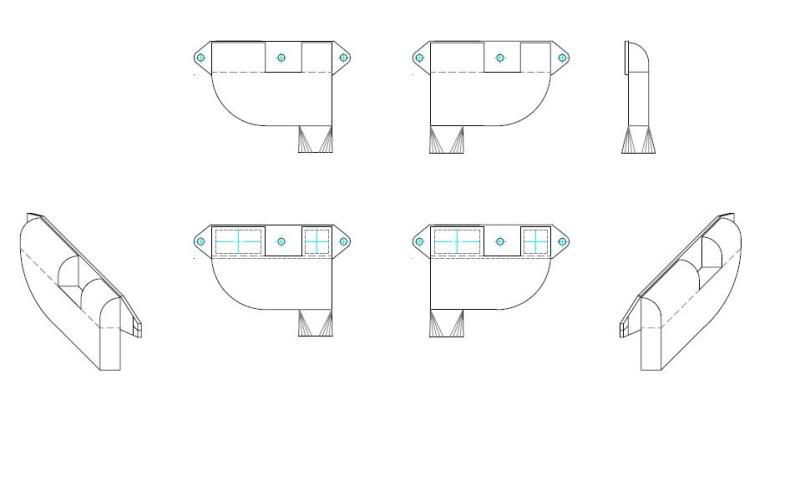
    While I was at work on Saturday I finished the AutoCAD drawing of the manifolds. Here's what I was trying to describe above. I couldn't quite figure out how to draw the exit pipes at the bottom back corner of the manifolds in the ortho views (bottom left and bottom right drawings below). I never was that good at drawing in ortho mode...

    Anyway, it will be a short piece of 2.5" round pipe that will transition from 2.5" diameter round on the bottom end to a 1.5" x 2.4" rectangle on the top end and then the rectangular end will be welded to a hole of the same size in the bottom back corner of each of the 1.5" x 4" main collector boxes...
    Last edited by R Counts; 12-08-2009 at 05:17 AM.

  5. #5

    Default

    Yes, a picture is worth a thousand words. I do understand the dilemma you are facing with the space limitations. You are almost at the old log style design that was popular on some of the older engines. Surprisingly they can be quite suitable especially on a smaller cube engine that is not revving past 3500 RPM. This design was also well suited to casting so the manufacturing cost was kept low. Please post some pictures when you are making them.
    Wayne

  6. #6

    Default

    Quote Originally Posted by WAYNESWORLD View Post
    Yes, a picture is worth a thousand words...
    Agreed - and with a few well-chosen words (description) to suppliment the picture it all becomes clearer still

    Quote Originally Posted by WAYNESWORLD View Post
    You are almost at the old log style design that was popular on some of the older engines...
    That is exactly where I got my inspiration - I figured if that type of design was good enough for the factory...

    Quote Originally Posted by WAYNESWORLD View Post
    Surprisingly they can be quite suitable especially on a smaller cube engine that is not revving past 3500 RPM.
    I'd say that pretty well describes my application - 262 cubic inches displacement, a 3600 RPM redline/HP peak, and peak torque at 1600 RPMs...

    Quote Originally Posted by WAYNESWORLD View Post
    This design was also well suited to casting so the manufacturing cost was kept low.
    In my case it is well suited to being fabricated in sections that I can then piece together - allowing for easier (and more low-profile) attachment of the runners to both the mounting flange AND to the collector .

    Quote Originally Posted by WAYNESWORLD View Post
    Please post some pictures when you are making them.
    Wayne
    You got it. Now if the weather and the rest of my LIFE will just quit conspiring together to keep me from getting to work on it

  7. #7

    Default

    Well, everything FINALLY came together and I got to try out my new SuperCut50 today! It only took a me a month to get around to actually using it.

    All I can say is WAHOOOO! This thing is S-W-E-E-T!

    I made a few cuts in some 1/4" plate to try it out. I cut one of my header mounting flanges and one of the motor mount pieces. I have to say, I am seriously impressed. The only limitation to how smooth and straight the cut you get with it is how steady your hand is.

    As far as I can see, there is only one disadvantage to using this machine to cut steel. That is the fact that it cuts so darned easy and fast that you have to be really careful, and watch what you're doing really closely - or you'll end up cutting farther than you want to - or get off track and make more of a cut than you want!

    I can see where with just a little practice I am going to absolutely LOVE using this little tool...
    Last edited by R Counts; 12-27-2009 at 01:07 AM.

Posting Permissions

  • You may not post new threads
  • You may not post replies
  • You may not post attachments
  • You may not edit your posts
  •